
Table of Contents
Don't have the time to read the entire post? Our human writers will be sad, but we understand. Summarize the post with your preferred LLM here instead.
As large language models (LLMs) move deeper into enterprise workflows, the need for seamless, scalable integration has become clear. Two emerging protocols—Model Context Protocol (MCP) and Agent2Agent (A2A)—address this challenge from different angles. Both are designed to reduce complexity, streamline operations, and support smarter automation.
While MCP and A2A are often thought of as competing protocols, they share similarities and are often used together to great effect. For some use cases, sticking to one or the other is ideal, but many organizations will unlock the most value by utilizing both.
This guide will cover:
What MCP is and how it works
What A2A is and how it works
Key differences between MCP and A2A
How to choose between or combine these protocols
What is MCP?
MCP is an open-source protocol that standardizes how LLMs such as ChatGPT or Claude connect with data sources and tools. Without MCP, connecting an LLM with Google, GitHub, and other external sources often requires several unique application programming interfaces (APIs). With MCP, you can leverage one protocol across most use cases.
Anthropic developed MCP to address issues faced by developers and end users related to this complexity. For developers, the core issue is the N×M problem, where N is the number of LLMs and M is the number of systems they need to integrate with. Each combination requires custom logic or infrastructure, leading to unsustainable complexity. For users, the main pain point is the friction caused by manually copying and pasting content between applications and interfaces.
MCP introduces several innovations to address these challenges, including:
Standardized contextualization enables models to receive structured context across tools.
State synchronization allows tools and agents to share memory or history with the model.
System interoperability ensures consistent behavior across tools, apps, and services.
The benefits of MCP include faster and more scalable integration of LLMs into existing tech stacks, reduced development overhead, and smoother user workflows. However, as with any system that facilitates access to third-party tools, security considerations—particularly around authorization mechanisms such as OAuth—remain critical and must be carefully managed at the implementation level. MCP security best practices, like using a dedicated authorization server separate from the resource server, and properly implementing OAuth 2.1, can help mitigate potential risks.
How MCP works
The underlying mechanisms that make MCP work are connections and trust between an LLM application and the bodies of data it’s authorized to access and process. This starts with a “protocol handshake” in which the client connects to MCP servers, determines what each dataset can do, and registers capabilities for future use in answering user demands.
Then, when users make a request that requires external data, the following steps typically occur:
Request analysis: The LLM analyzes the user’s prompt and determines that it needs information beyond its current context.
User consent: The LLM prompts the user to authorize access to the relevant external system or dataset, if needed.
Access request: The LLM sends a structured request to the MCP server using a standardized schema.
Data provisioning: The MCP server evaluates the request, checks permissions, and returns the appropriate data or tool output.
Context integration: The LLM incorporates the new information into its session context.
Response generation: The LLM uses the enriched context to generate a more accurate, informed response.
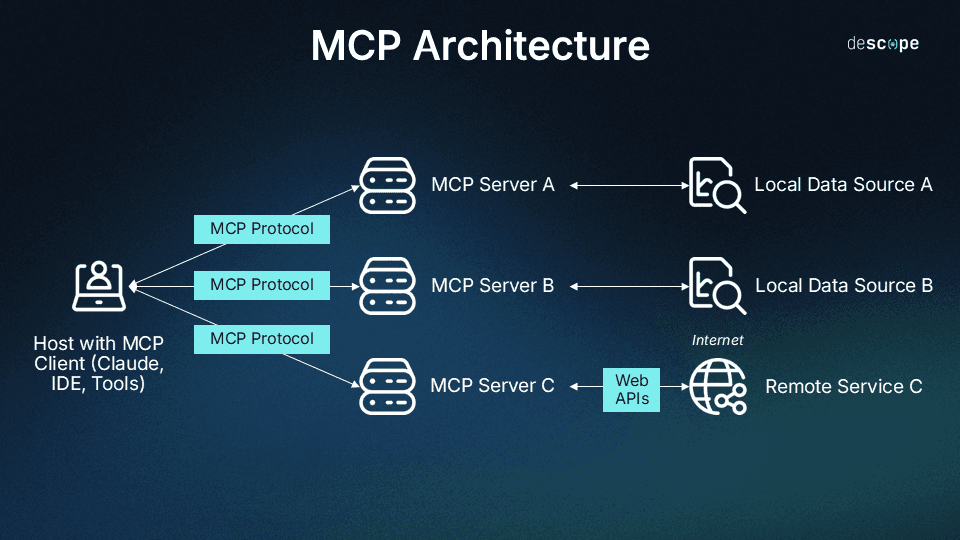
Though this may seem like a multi-step workflow, the exchange typically happens in milliseconds, allowing users to receive responses without the hassle of repeatedly feeding information into the LLM to answer similar questions.
What is A2A?
A2A is a coordination layer between agents. While MCP focuses on helping LLMs interact with external data sources and tools, Google’s A2A protocol enables autonomous agents to communicate and collaborate with one another. Google announced A2A in April of 2025, touting the massive collaborative effort that went into its development. The result of 50+ partners coming together was a solution that allows agents to work in concert in their raw states, even without sharing direct access to the same resources that agent-to-agent synchronicity typically needed.
Like MCP, this protocol was born out of a necessity to simplify and scale LLM and agent utility. Additionally, Google lists security, support for legacy processes, and modality agnosticism (i.e., not tied to specific input/output formats like text, images, or speech) among the core design principles that make A2A what it is today.
Through this structure, A2A enables four foundational capabilities:
Capability discovery: Agents can query one another to identify which tools, actions, or processes are best suited to fulfilling a user's request.
Task management: Agents can determine and report on status dynamically as a task is being completed, communicating with each other to ensure synchronization throughout.
Collaboration: Agents can ask each other questions, answer them semi-independently, and generate useful outputs such as artifacts or instructions for optimal user visibility.
UX negotiation: Agents talk with each other to determine the best ways to present information to users, taking into account format, accessibility, and user background.
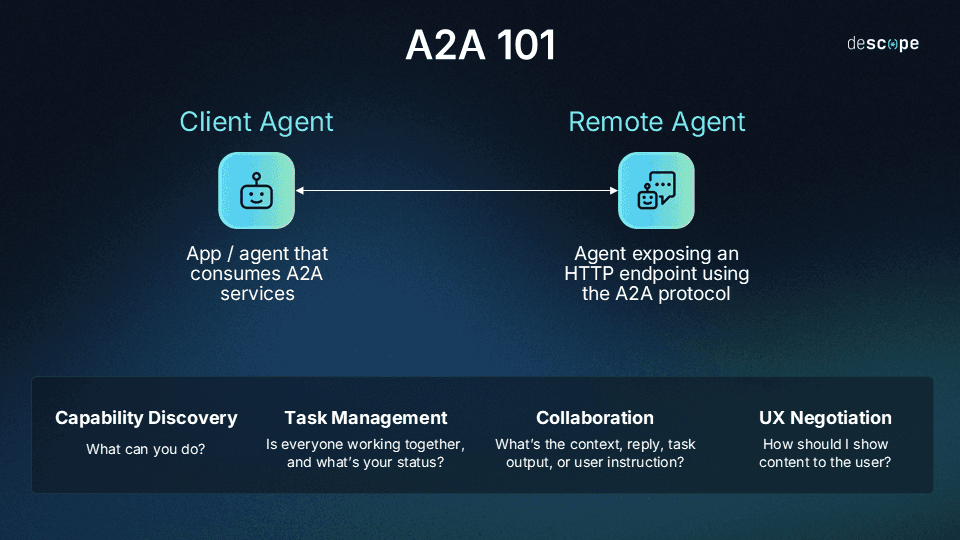
Together, these features allow agents to function more cooperatively across ecosystems, offering a more seamless experience for users and less custom integration work for developers. However, A2A is still in its early days. It doesn’t yet support fully autonomous agent networks, and organizations must actively manage the evolving risks associated with early-stage interoperability protocols.
How A2A works
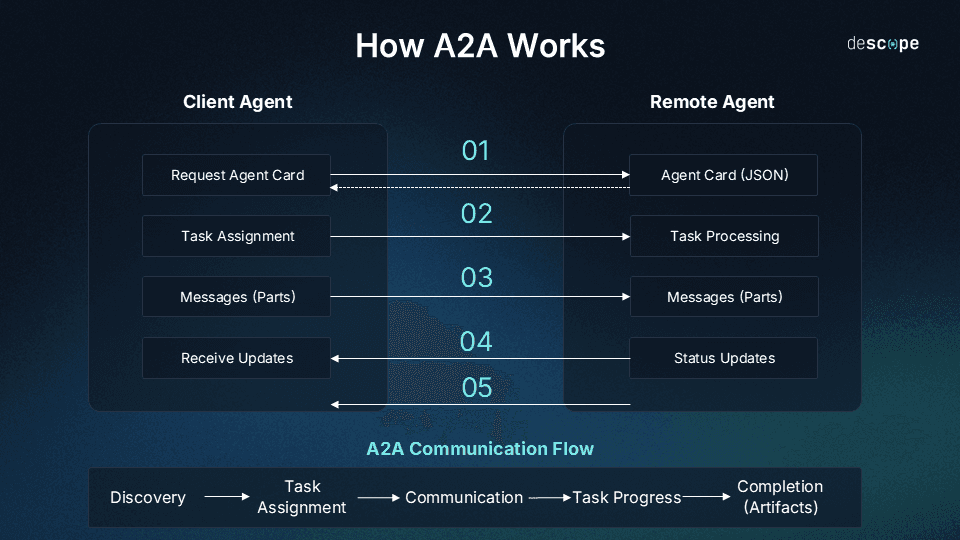
A2A enables AI agents—powered by LLMs or similar models—to communicate and collaborate via standardized protocols like HTTP, using structured JSON messages sent over an A2A server.
Before agents begin working together, they establish mutual trust through the exchange of Agent Cards. These cards describe an agent’s capabilities and supported actions without exposing proprietary implementation details, allowing interoperability without sacrificing privacy or security.
The typical A2A interaction unfolds as follows:
User request: A user prompts an AI agent to perform a complex task.
Agent coordination: The initiating agent determines that it needs help from other agents to fulfill the request.
Agent card discovery: The initiating agent reviews available Agent Cards to assess which other agents are best suited for specific subtasks.
Delegation: The initiating agent delegates parts of the task to selected external agents.
Dynamic communication: The agents communicate in real time, coordinating efforts and sharing intermediate results.
Progress updates: The initiating agent provides the user with task status updates throughout the process.
Artifact generation: Once the task is complete, the initiating agent compiles final outputs (e.g., reports, recommendations, or structured data artifacts).
This approach effectively helps a single AI tool to punch above its weight and marshal the expertise and functionality of multiple external agents. Thus delivering better results with less manual input from the user.
Read more: Introducing Descope Agentic Identity Hub 2.0
A2A vs MCP: Key differences explained
A2A and MCP are more similar than they are different in the utility they bring to organizations integrating AI and agentic workflows. However, there are some key differences regarding purpose, how they work, and the specific benefits they offer:
| MCP | A2A |
|---|---|---|
Purpose | Allows LLMs to access external data sources | Enables agent collaboration on complex tasks |
How it works | An LLM determines it needs access and initiates authorization requests to complete a user query | An agent determines it needs help, searches for compatible agents, and makes requests |
Benefits | Scalable LLM integration, reduced development overhead, smoother user workflows | Simple LLM scalability, security, support for legacy processes, modality agnosticism |
Because of these differences, there are many cases where MCP and A2A are used together.
A2A vs MCP or A2A + MCP?
For development teams considering how to streamline authentication, authorization, and system interoperability, understanding the difference between MCP and A2A is essential, but not always straightforward. Both protocols are designed to improve communication between systems and agents, and both can play a role in modernizing enterprise workflows.
The truth is: MCP and A2A are more complementary than competitive, and they’re designed to work together. MCP focuses on helping a single LLM or agent interact with external tools and data sources. A2A, on the other hand, facilitates communication and collaboration between multiple agents, regardless of whether they share direct access to those same resources.
Together, MCP and A2A allow agents to access external data and collaborate seamlessly.
Security considerations
Both protocols can expand the "surface area" of interaction, introducing new layers of logic and communication. But neither MCP nor A2A inherently introduces more risk. Their security posture depends heavily on the configuration and vulnerabilities of the systems they connect to. In both cases, standard best practices—such as robust authentication, least privilege access, and monitoring—are essential.
Choosing (or combining) the right protocol
The best fit depends on your specific use case:
Use MCP when your primary need is for a single LLM to draw from internal data or tools to complete user tasks.
Use A2A when you’re focused on coordinating multiple AI agents to carry out more distributed or collaborative workflows.
Use MCP and A2A when you need LLMs to access the tools they need and collaborate with other agents across systems.
In most cases, the ideal approach is not either/or—it’s both.
For optimal results, both protocols should be implemented alongside a secure authorization stack, including features like multi-factor authentication (MFA) and fine-grained access controls, to ensure safety without sacrificing flexibility. All of this can often be achieved with minimal code overhead.
MCP and A2A: The beginning of a new era
Together, MCP and A2A represent a shift toward a more modular, cooperative future for AI systems—one where agents can access the right data, coordinate effectively, and adapt to complex workflows with less overhead. Whether you're building smarter interfaces, streamlining internal tools, or experimenting with agent-based automation, these protocols offer a solid foundation.
If you're looking to secure AI apps, agents, MCP servers, or chatbots, Descope can help. The Descope Agentic Identity Hub is a dedicated identity provider for AI agents that provides necessary identity-layer infrastructure like OAuth 2.1 / PKCE, scoped and short-lived AI agent credentials, and policy controls to ensure least privilege access. Moreover, the Descope MCP Express SDK and Python MCP SDK help developers secure remote MCP servers for scoped and consented access.
Sign up for a Free Forever account with Descope and start building secure, scalable auth flows today. Have questions about MCP and/or A2A-powered auth? Book time with our experts.