Los Altos, CA, November 20, 2025 – Descope, the drag & drop external IAM platform, commissioned a survey of 416 individuals with technical and / or budgetary responsibility for Customer Identity and Access Management (CIAM) solutions. The State of Customer Identity study found organizations struggling with subpar authentication methods and legacy systems, but not being able to find the time or budget to move towards methods and systems better suited to their users. Readers interested in studying the complete survey report can download a copy here.
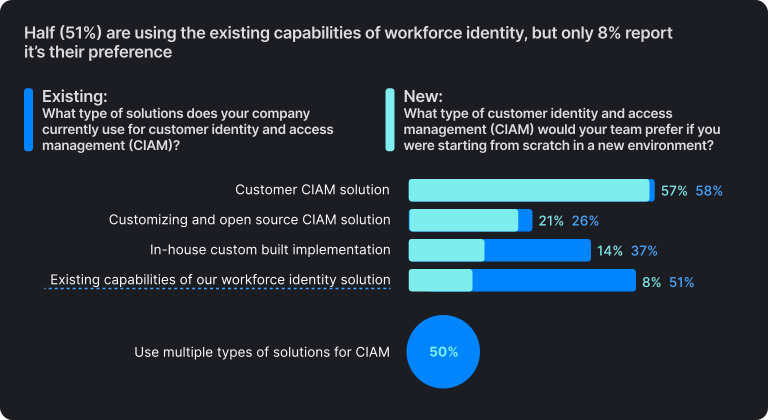
Notably, the study found that while 87% of organizations use password-based authentication for their customer-facing applications, only 2% felt it was the most effective method to balance security and user experience. The same theme of remorse came across in the solutions used to implement CIAM: while 51% of organizations use their existing workforce IAM to implement customer auth, only 8% would choose to do the same if they were to start from scratch.
These patchwork implementations end up affecting the bottom line, with 82% of survey respondents citing at least some negative business impact. Around 52% faced high costs related to auth support tickets, 37% delayed product launches due to identity-related development tasks, and 30% suffered user dropoffs due to complex onboarding.
“This study puts quantitative weight behind what we’ve been hearing from hundreds of organizations,” said Rishi Bhargava, co-founder of Descope. “Engineering and identity teams are trying to fit square pegs into round holes when it comes to customer identity. Maintaining homegrown or workforce-based solutions with overstretched development teams is a recipe for falling behind as user needs evolve, new product needs arise, or AI agents are added to the mix.”
Overstretched developers
The survey responses shed light on how organizations are tasking already overburdened developers with CIAM responsibilities without the required supporting systems in place, causing the business and security ramifications highlighted above.
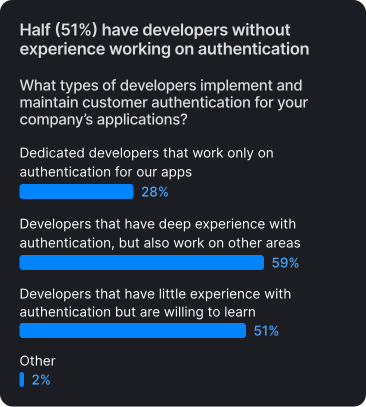
51% of organizations task developers with minimal to no authentication experience to build and manage CIAM
Only 28% of organizations report having dedicated CIAM engineers
46% of organizations cite delaying identity-related projects due to competing product priorities
The true cost of open-source CIAM
Using open-source solutions to implement CIAM is a popular choice for flexibility and low surface-level costs, but survey results highlighted the ongoing cost of relying on open-source solutions.

50% of organizations using open-source CIAM faced revenue losses / user dropoffs due to strict authentication, compared to 26% of organizations that used commercial CIAM
51% of organizations using open-source CIAM experienced security incidents after implementing low-friction authentication, compared to 39% of organizations that used commercial CIAM
55% of organizations using open-source CIAM have cancelled or delayed CIAM upgrades due to competing product and engineering priorities
The importance of agentic identity controls
Most organizations are exploring the idea of adopting AI agents or MCP servers, but the need for identity guardrails are often stopping these projects from reaching full production. Security concerns about over-permissioned AI agents and lack of governance controls continue to rise.
88% of respondents are using or planning to use AI agents, but only 37% have progressed beyond pilot programs
57% of respondents are concerned about AI agents accessing unauthorized data or sharing data with unauthorized users
46% of respondents cite their engineering teams not having the required time or expertise to build and manage agentic identity systems
Readers interested in studying the complete survey report can download a copy here.
Methodology
The survey was commissioned by Descope and conducted by Dimensional Research. Independent sources of technology stakeholders were invited to participate in an online survey. A variety of questions were asked on current approaches and experiences with customer identities and authentication. Responses were captured between June 6 – 24, 2025. The survey was fielded in English. A total of 416 qualified individuals completed the survey. All had decision making responsibility (technical and/or budget) for Customer Identity and Access Management (CIAM) solutions at a company with more than 500 employees.
About Descope
Descope is a drag & drop platform to help organizations manage all their external identities. Our no / low code solution helps organizations create, modify, and secure authentication and authorization journeys for customers, partners, AI agents, and MCP servers. Over a thousand organizations use Descope to improve customer experience, prevent account takeover, and securely adopt agentic AI and MCP.
Descope Media Contact
Erica Anderson
Offleash for Descope
descope@offleashpr.com